Whenever drivers ask us for a definitive timeline on vehicle maintenance, we can usually provide a pretty solid answer. If you ask about an oil change, we will tell you to look at the windshield sticker or target every five thousand to ten thousand miles depending on your engine type. If you ask about your engine air filter, a quick annual check usually does the trick. But when a customer asks us exactly how often their brake pads need to be replaced, the answer gets a bit more complex.
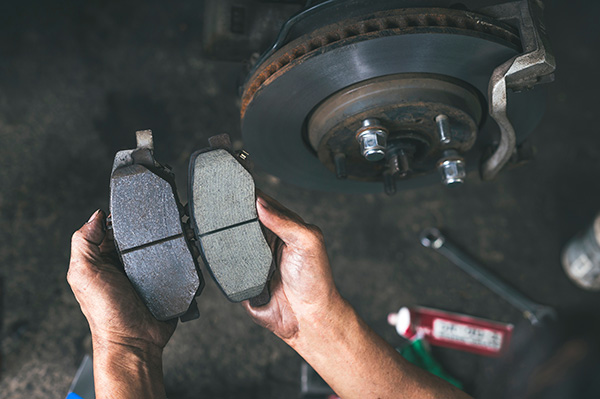
The honest answer we give from the service counter is simple: it depends. Unlike components that run on a strict clock, brake pads are sacrificial wear items. They are designed to physically destroy themselves over time to protect your vehicle and bring your rolling mass to a safe, controlled stop. Let us pull back the wheels and take a realistic look at the numbers behind brake pad longevity, the factors that accelerate wear, and the warnings your vehicle sends when the rubber, or rather the friction material, meets the road.
The Realistic Mileage Windows
Because every single driver has completely unique driving habits, the lifespan of a set of brake pads can vary wildly. On average, most passenger cars and SUVs need new brake pads somewhere between 30,000 and 70,000 miles. That is a pretty massive gap, and it explains why a blanket recommendation doesn't always work.
We have seen heavy commuter vehicles roll into our garage with completely bald pads at just 25,000 miles, and we have seen highway cruisers stretch a single set of quality ceramic pads all the way past 80,000 miles. It all boils down to your personal driving environment and daily habits.
What Speeds Up the Clock on Your Brakes
To understand why your friend's brakes last longer than yours, look at the daily operating conditions. Several major factors dictate how quickly that friction material wears down to the metal backing plate.
City vs Highway Driving: If your daily commute consists of stop-and-go city traffic, traffic lights, and pedestrian crossings, you are riding your brakes constantly. Every application generates immense friction and heat. Highway drivers might go fifty miles between taps, meaning their pads stay cool and last significantly longer.
Vehicle Weight and Cargo: Physics is incredibly unforgiving. A compact sedan requires much less kinetic energy to stop than a large three-row SUV or a work truck hauling heavy tools. The heavier the vehicle, the harder the brake calipers must squeeze, grinding away the pad material at a much faster rate.
Driving Style: If you are the type of driver who loves to accelerate quickly and wait until the absolute last moment to press the brake pedal firmly before a red light, you are putting extreme thermal stress on the system. Smooth coasting and early braking preserve your pads dramatically.
The Brake Warnings You Cannot Ignore
Thankfully, you do not have to guess about the state of your brakes. Modern brake systems are engineered to speak to you directly when the friction material gets critically low.
The first sign is often a high-pitched squealing or screeching sound when you press the pedal. Most brake pads feature a tiny, built-in metal clip called a wear indicator. When the pad wears down to roughly two millimeters of thickness, this metal tab physically scrapes against the brake rotor, creating a loud warning noise.
If you ignore the squeal, that sound will eventually transform into a harsh, deep metallic grinding or growling noise. This means the friction material is completely gone, and you are now grinding the raw metal backing plate of the pad directly into your steel brake rotor. This metal-on-metal contact destroys your stopping power instantly and ruins your rotors, dramatically increasing your repair bill.
You might also feel a distinct pulsing or shaking through the brake pedal or steering wheel when slowing down from highway speeds. This often indicates that the intense heat from worn pads has caused your brake rotors to develop uneven thickness variations, meaning the system can no longer apply smooth, even pressure.
Why a Professional Inspection Matters
A lot of drivers wait for a dashboard warning light to illuminate before thinking about their brakes. While some modern luxury vehicles feature electronic pad wear sensors, the vast majority of vehicles on the road rely entirely on visual inspection.
When you bring your vehicle to Premier Automotive Service in Urbandale, IA for a routine oil change or tire rotation, our technicians visually measure your pads using specialized precision gauges. We measure the inner and outer pads in millimeters, ensuring they are wearing evenly. We also check the condition of your brake fluid, look for caliper leaks, and inspect the surface of your rotors to ensure your entire stopping system is working satisfactory.
Your brakes are the single most important safety system on your vehicle. You should never have to second-guess whether your car will stop in an emergency situation. If you are approaching that 30,000-mile mark, if your brakes are starting to make an unusual noise, or if the pedal feels a bit soft under your foot, it is time to have a pro take a look.
Let Us Keep Your Stopping Power Sharp
Noticing a squeak when you slow down or realizing it has been years since your last brake check? Do not take chances with your safety on the road. Stop by Premier Automotive Service in Urbandale, IA or book your brake inspection online today, and let our friendly team keep your vehicle stopping smooth and safe!